
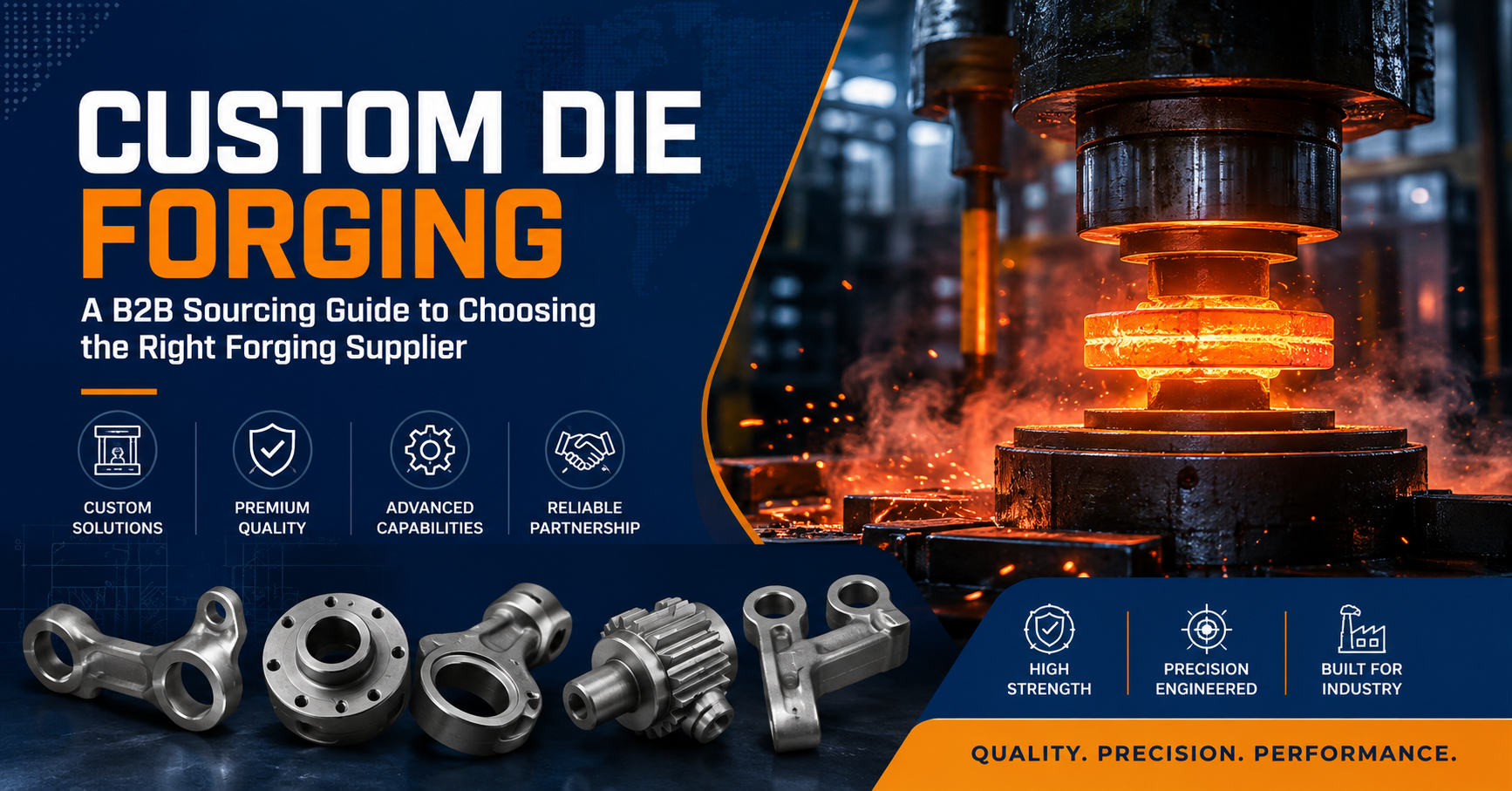
10 Aug Custom Die Forging: A B2B Sourcing Guide to Choosing the Right Forging Supplier
For B2B buyers in the automotive, aerospace, oil and gas, energy, construction equipment, and industrial machinery industries, choosing the right Custom Die Forging Supplier is critical to product quality, production costs, delivery schedules, and long-term supply chain stability.
Custom Die Forging is a manufacturing process that uses specially designed dies to shape heated metal into customized components. Compared with machining or casting, forging can provide excellent mechanical strength, consistent production quality, and efficient material utilization for many high-performance applications.
However, successful B2B sourcing is not simply about finding the lowest quotation.
When evaluating a Custom Forging Manufacturer, buyers should consider tooling capabilities, material control, forging capacity, heat treatment, CNC machining, quality certifications, material traceability, production lead times, and total cost.
1. What Is Custom Die Forging?
Custom Die Forging is a metal forming process in which a heated metal billet is placed between specially designed dies and shaped under high pressure.
Unlike standard or off-the-shelf forgings, custom forged parts are manufactured according to the customer’s:
- 2D engineering drawings
- 3D CAD models
- Material specifications
- Dimensional tolerances
- Mechanical requirements
- Surface requirements
- Production volumes
- Industry standards
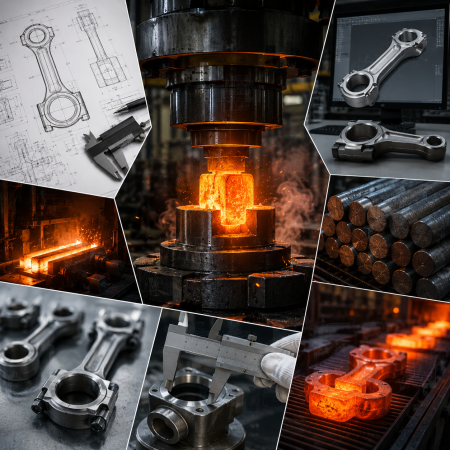
During the forging process, the metal flows into the die cavity to create the required component geometry.
This makes Custom Die Forging particularly suitable for components that require high strength, durability, and consistent mechanical performance.
Typical applications include:
Shafts, gears, axles, connecting rods, flanges, brackets, valve components, Hydraulic components, Industrial machinery parts and automotive components
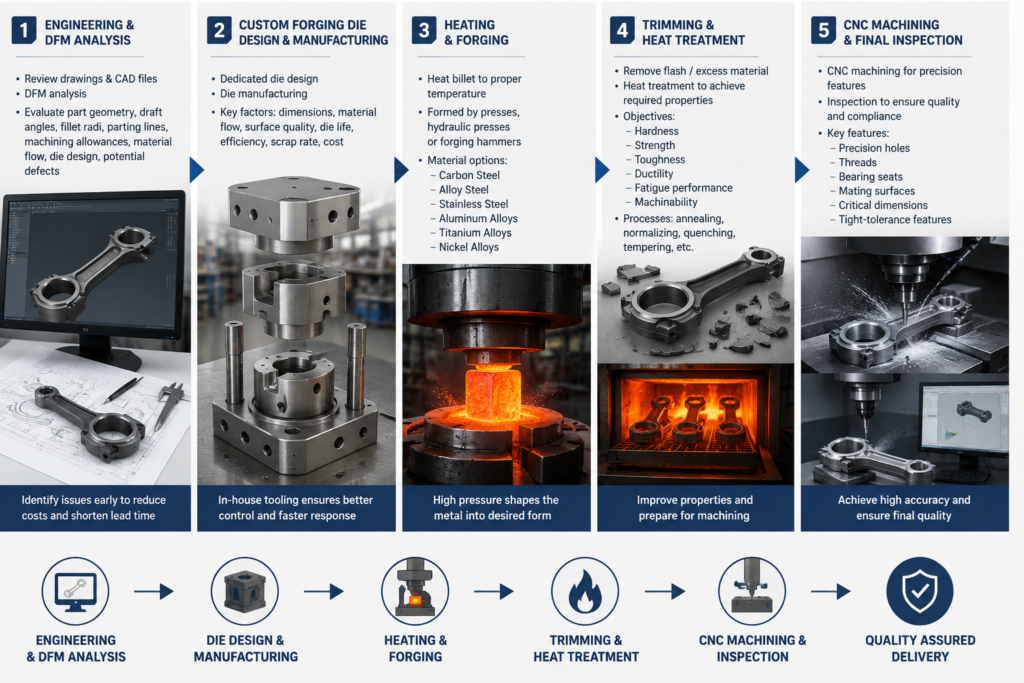
2. How Does the Custom Die Forging Process Work?
A typical Custom Die Forging project involves several engineering and manufacturing stages.
3. Why Choose Custom Die Forging for B2B Manufacturing?
For B2B buyers, the most important question is not simply which manufacturing process has the lowest initial price.
The better question is:
Which manufacturing process provides the best combination of performance, quality, production efficiency, and total cost?
Advantages.of Custom Die Forging
Higher Strength and Fatigue Performance
The forging process can create favorable metal grain flow that follows the general shape of the component.
This can contribute to high strength and fatigue resistance, making forged components suitable for demanding applications involving impact, cyclic loading, and mechanical stress.
Reduced Material Waste
Compared with producing a component entirely through CNC machining, forging can bring the material closer to its final shape before precision machining.
This can reduce:
- Material consumption
- Machining time
- Cutting volume
- Production costs
Consistent Production for High-Volume Orders
Custom tooling requires an initial investment.
However, when production volumes are sufficiently high, the tooling cost can be distributed across a large number of components.
As a result, Custom Die Forging can become highly competitive for medium- and high-volume B2B production.
Near-Net-Shape Manufacturing
A well-designed forging process can produce components close to their final geometry.
This near-net-shape manufacturing approach can reduce the amount of material that must be removed during subsequent CNC machining.
The result can be shorter machining cycles, lower material waste, and improved overall production efficiency.
4. How to Choose a Custom Die Forging Supplier
Choosing the right Custom Forging Supplier is one of the most important steps in the B2B sourcing process. A supplier that can provide a low quotation is not necessarily the best long-term manufacturing partner.Buyers should evaluate the following areas.
1. Check In-House Tooling Capability
A capable tooling department should be able to support:
- Die design
- Die manufacturing
- Die modification
- Die maintenance
- Tool optimization
In-house tooling can reduce communication between multiple suppliers and potentially shorten tooling development cycles.
2. Evaluate Forging Equipment and Production Capacity
The supplier’s equipment must be suitable for the size, weight, geometry, and material of the component.
Important specifications include:
- Forging press capacity
- Hammer capacity
- Furnace capacity
- Maximum part weight
- Maximum part dimensions
- Production capacity
- Available forging lines
A manufacturer experienced in small precision forgings may not necessarily have the equipment required for large industrial components.
3. Verify Material Traceabilit
For critical industrial components, material traceability is an essential part of supplier qualification.B2B buyers may request documentation such as:
- Material certificates
- Mill certificates
- Heat numbers
- Batch numbers
- Heat treatment records
Proper traceability helps buyers track materials from the original batch through manufacturing and final inspection.
4. Check Quality Certifications
Depending on the target industry, buyers may require certifications such as:
- ISO 9001
- IATF 16949
- AS9100
In addition to certifications, buyers should evaluate the supplier’s ability to provide:
- First Article Inspection (FAI)
- Dimensional inspection reports
- Hardness testing
- Tensile testing
- Non-Destructive Testing (NDT)
- PPAP documentation
Certification alone does not guarantee product quality, but a structured quality management system is an important indicator of manufacturing capability.
5. Compare Total Cost Instead of Unit Price
One of the most common mistakes in B2B sourcing is comparing suppliers only by their quoted unit price.A better approach is to evaluate the total manufacturing cost:
Total Cost = Tooling + Material + Forging + Heat Treatment + Machining + Inspection + Logistics
A supplier with a slightly higher unit price may ultimately provide a lower total cost if it offers:
- Better yield
- Longer tool life
- Lower scrap rates
- Fewer quality issues
- Shorter lead times
- Better production stability
For long-term sourcing programs, total cost and supply chain reliability are often more important than the lowest initial quotation.
5. Custom Die Forging FAQ
What is Custom Die Forging?
Custom Die Forging is a manufacturing process that uses specially designed dies to shape metal into customized components based on a customer’s drawings, material requirements, and specifications.
What materials can be used for Custom Die Forging?
Common materials include carbon steel, alloy steel, stainless steel, aluminum alloys, titanium alloys, and selected nickel-based alloys. The appropriate material depends on the component’s mechanical requirements, operating environment, temperature, corrosion resistance, and applicable standards.
Is Custom Die Forging suitable for small quantities?
Yes, but tooling costs should be considered. Because custom dies require an initial investment, the unit cost may be relatively high for very small production runs. Custom Die Forging generally becomes more cost-effective as production volume increases.
How much does a Custom Forging Die cost?
Tooling costs vary depending on part size, geometry, complexity, material, die steel, expected tool life, and production volume. An accurate tooling quotation normally requires a 2D engineering drawing and/or 3D CAD model.
Can forged parts be CNC machined?
Yes. Many industrial components are manufactured using a combination of Forging, Heat Treatment, CNC Machining, and Final Inspection. This approach combines the structural benefits of forging with the dimensional accuracy of CNC machining.
How do I choose a Custom Die Forging Supplier?
Evaluate the supplier based on tooling capabilities, forging equipment, material expertise, quality certifications, traceability, heat treatment, CNC machining, production capacity, lead time, quality performance, and total cost.
What information is needed for a Custom Forging RFQ?
A typical RFQ package should include a 2D drawing, 3D CAD model, material specification, order quantity, annual volume, quality requirements, heat treatment requirements, machining requirements, inspection standards, and packaging specifications.
For B2B buyers, Custom Die Forging is more than a metal forming process. It is part of a larger manufacturing and supply chain strategy. A capable Custom Forging Manufacturer should ideally support the complete production chain:
Engineering → Tooling → Forging → Heat Treatment → CNC Machining → Inspection → Mass Production
When sourcing a forging supplier, buyers should look beyond the lowest unit price and evaluate the complete combination of:
Quality + Tooling Capability + Production Capacity + Lead Time + Traceability + Total Cost
Choosing the right Custom Die Forging Supplier can help manufacturers achieve consistent product quality, reduce sourcing risks, improve production efficiency, and build a reliable long-term B2B manufacturing partnership.
If you have a forging drawing, 3D CAD model, material specification, or annual volume requirement, a qualified forging manufacturer can evaluate the design, recommend the appropriate forging process, and prepare a customized RFQ.
Sorry, the comment form is closed at this time.