
24 Aug How to Choose the Right Forging Machine
Forging is a very important metal forming process. By applying pressure or impact force to cause plastic deformation of metal, forging can produce metal components with high strength, good toughness, and reliable performance. It is widely used in industries such as automotive, engineering machinery, railway, agricultural machinery, and aerospace.
Common forged parts include gears, flanges, connecting rods, steering knuckles, shaft components, suspension system components, and various structural parts. Compared with cast parts, properly designed and manufactured forged parts can generally achieve better mechanical properties and more reliable internal structures. Therefore, they are widely used in applications where safety and durability are critical.
However, whether a forged part can ultimately achieve the expected dimensional accuracy, mechanical properties, and production efficiency depends not only on the material and tooling, but also closely on the selection of the forging machine.
So, when faced with different types of forging equipment, how should manufacturers choose the right one?
1. The Different Types of Forging Machines
Based on the principle by which the forming force is generated, common forging machines used in industrial production can be divided into mechanical forging presses, hydraulic forging presses, screw presses, and forging hammers.
Based on the principle by which the forming force is generated, common forging machines used in industrial production can be divided into mechanical forging presses, hydraulic forging presses, screw presses, and forging hammers.
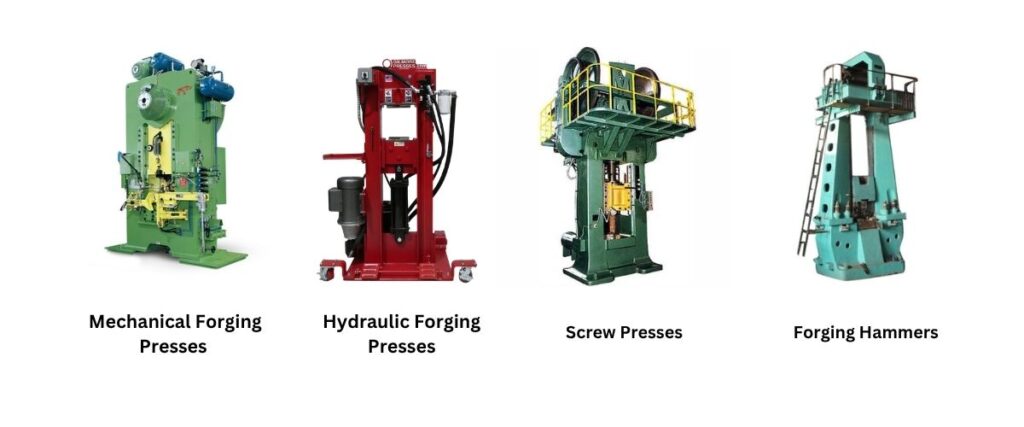
Mechanical Forging Presses
Mechanical presses typically generate forming force through mechanical transmission mechanisms such as cranks and flywheels. They offer high production speeds, good repeatability, and are well suited for continuous production.
For high-volume production of automotive components and standardized mechanical parts, mechanical presses offer high production efficiency. One particularly important point to note is that the rated tonnage does not mean that the machine can continuously deliver the same maximum force throughout the entire stroke. When selecting equipment, it is necessary to confirm whether the actual peak forming force occurs within the machine’s allowable rated-pressure range.
Hydraulic Forging Presses
Hydraulic forging presses generate forming force through a hydraulic system and can provide controllable forming force over a relatively large stroke range.
They are particularly suitable for large, complex components or parts requiring substantial deformation. Hydraulic systems can also adjust pressure, speed, and stroke, making them advantageous for certain hot forging processes, large forgings, and applications requiring a high degree of control over the forming process.
Screw Presses
Screw presses transfer energy to the slide through mechanisms such as a screw and flywheel. One of their important characteristics is that equipment selection requires consideration not only of the maximum forming force but also of the energy available per blow.
For forgings that require multiple forming operations, complex die cavity filling, or significant deformation, screw presses can provide good adaptability. When selecting this type of equipment, it is therefore important not to consider tonnage alone, but also to calculate the actual energy required for forming.
Forging Hammers
Forging hammers generate substantial instantaneous forming energy through high-speed impact and have traditionally been widely used for open-die forging and certain large-scale, rough-forming processes.
Their characteristics include strong impact force and high forming speed. However, compared with modern presses, the impact process can result in greater vibration, noise, and die wear. Therefore, for modern, automated, and high-precision production lines, it is necessary to determine whether a forging hammer is appropriate based on the specific process requirements.
2. What Does 3 MN–25 MN Actually Mean?
When we see 3 MN–25 MN in forging equipment specifications, MN represents force.
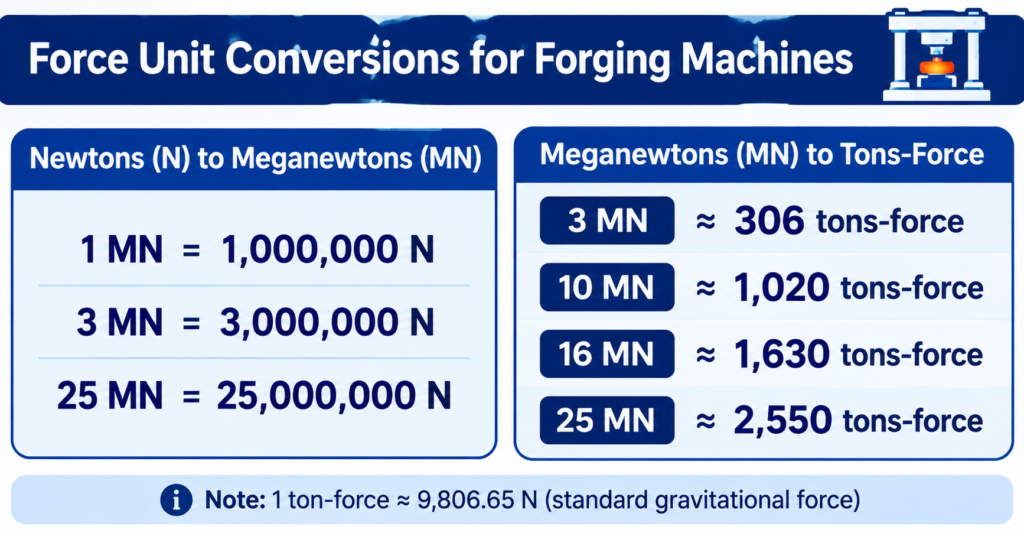
Therefore, the so-called “3 MN–25 MN forging machine range” essentially means that the equipment can provide forging forces ranging from approximately 300 tons to 2,500 tons.
Taking NAO GMBH’s equipment capabilities as an example, our hot forging presses range from 3 MN to 25 MN, and we operate 16 automated forging production lines. This range covers a wide variety of production requirements, from small and medium-sized forgings to larger industrial forgings.
3. What Factors Should Be Considered When Choosing a Forging Machine?
Part Size and Weight
First, it is necessary to determine the maximum length, width, height, weight, and projected area of the forged part.
Larger parts generally require a larger die working space and greater forming capacity. However, equipment tonnage cannot be determined simply based on the weight of the part, because forging force is also related to the projected area of the part, material flow stress, friction, and forming method.
In engineering calculations, the peak forming force can be initially estimated based on the projected area of the part and the average flow stress of the material at the forging temperature:
F ≈ A × σ̄flow
where A represents the projected area and σ̄flow represents the average flow stress of the material at the forging temperature. Actual calculations also need to take factors such as friction and die cavity filling into consideration.
Material Type
Different materials have significantly different deformation resistance at different temperatures.
For example, aluminum alloys, stainless steels, alloy steels, copper, and high-temperature alloys have different forging temperatures and material flow stresses. Therefore, two parts with the same dimensions may not necessarily require forging machines with the same tonnage.
It is particularly important to note that hot forging cannot simply use the same pressure calculation method as cold stamping. The flow stress of a material changes significantly at elevated temperatures, so equipment selection must take into account the actual forging temperature and material characteristics.
Forging Process: Cold, Warm, or Hot Forging?
This is one of the key factors in equipment selection.
Cold forging is generally performed at or near room temperature and places high demands on equipment rigidity, forming force, and die life. It is suitable for high-precision, small components produced in large volumes.
Warm forging falls between cold forging and hot forging. It reduces the material’s deformation resistance while maintaining relatively good dimensional accuracy.
Hot forging generally requires the material to be heated to an appropriate forging temperature, making it easier for the material to undergo plastic deformation. It is therefore suitable for forming large, complex, or high-strength components.
Different processes require different levels of pressure, speed, stroke, and temperature control.
Equipment Tonnage and Safety Margin
The rated tonnage of the equipment must be higher than the peak load required during actual production.
However, the safety margin should not be increased indefinitely. Relevant engineering references suggest that, based on the calculated peak load, an additional margin can be considered to account for factors such as friction variations, temperature fluctuations, die wear, and eccentric loading. A commonly referenced engineering range is approximately 20%–40%, although the specific value should be determined according to the material, process, and equipment type.
For example, if process calculations and simulations indicate that the maximum forming force for a particular part is approximately 10 MN, the equipment should not simply be selected as a machine rated at “exactly 10 MN.” Instead, the safety margin, equipment rated-pressure curve, die life, and actual production conditions should also be evaluated.
Stroke, Speed, and Production Cycle Time
Equipment tonnage is only one part of the selection process.
The following factors must also be considered:
- Whether the slide stroke meets the forming requirements of the part;
- Whether the table dimensions can accommodate the dies;
- Whether the forming speed is suitable for the material and process;
- Whether the individual production cycle meets the required production capacity;
- Whether the automatic feeding and part removal systems can match the production line cycle time.
For high-volume automotive component production, a machine that has sufficient forming force but cannot meet the required production cycle time is still not an ideal choice.
Die Life and Equipment Rigidity
During forging, the equipment and dies are subjected to extremely high loads.
If the equipment does not have sufficient rigidity, the slide, worktable, or frame may undergo significant elastic deformation, which can affect die closure and the final dimensions of the forged part.
Therefore, equipment selection should not be based solely on the “tonnage” stated on the nameplate. Attention should also be paid to:
Frame rigidity + guide precision + worktable structure + die dimensions + load distribution.
This is particularly important for high-precision forgings.
Level of Automation
Modern forging production is placing increasing emphasis on automation.
Automatic loading, robotic handling, transfer mechanisms, automatic spray lubrication, temperature monitoring, and production data collection can all reduce manual operations and improve product consistency.
If a company plans to carry out long-term, high-volume production, it should consider the automated forging production line at the time of purchasing the forging machine, rather than simply purchasing an individual press.
Energy Consumption, Maintenance, and Total Cost of Ownership
The equipment purchase price is only one part of the acquisition cost.
What truly needs to be considered is the total cost throughout the equipment’s lifecycle, including:
Equipment purchase cost + installation and foundation + energy consumption + die wear + maintenance costs + labor costs + downtime losses.
This is also why “a larger forging press” does not necessarily mean “a better forging machine.” Although larger equipment can handle heavier and larger parts, it may also involve higher energy consumption, greater factory space requirements, higher foundation requirements, and more complex maintenance.
4. The Consequences of Choosing an Inappropriate Forging Machine
1. Insufficient Equipment Tonnage: The Part Cannot Be Properly Formed
If the equipment does not have sufficient capacity, the most direct problem is that the die cavity may not be completely filled.
This can result in:
- Dimensional nonconformity;
- Local underfilling;
- Folding or other forming defects;
- Reduced consistency between production batches;
- Abnormal loads on the dies and equipment.
In severe cases, long-term operation under excessive load may also cause equipment damage. Relevant engineering analysis similarly indicates that an undersized press can result in incomplete die filling and dimensional defects.
2. Oversized Equipment: Increased Investment and Operating Costs
On the other hand, the idea that “buying a larger machine can never hurt” is also problematic.
Oversized equipment may result in:
- Higher purchase costs;
- Higher energy consumption;
- Larger equipment footprint;
- Higher factory and foundation requirements;
- More complex maintenance;
- Low equipment utilization.
Therefore, equipment should be matched to actual production requirements rather than simply pursuing maximum forming force. Articles published by Baidu B2B Wiki also emphasize that although large forging presses are suitable for heavy components and high-volume production, their energy consumption, maintenance, space, and foundation costs also increase accordingly.
3. Choosing the Wrong Equipment Type: Lower Efficiency and Product Quality
For example, if a component requires high-frequency, high-volume production but equipment that is not suitable for high-speed continuous production is selected, the production cycle may become too long.
Conversely, if a complex deep-forming component requires good control over pressure and speed, selecting equipment solely based on maximum tonnage may also fail to achieve the desired forming results.
Therefore, “tonnage matching” is only the first step; “process matching” is even more important.
4. Ignoring Die and Equipment Compatibility
Even if the equipment has sufficient tonnage, mismatches in worktable dimensions, die space, stroke, or guide precision may still prevent the machine from operating properly.
Therefore, before purchasing equipment, it is best to provide the following information at the same time:
- Product drawings;
- Material grade;
- Billet dimensions;
- Forging temperature;
- Die dimensions;
- Target production volume;
- Product accuracy requirements.
For complex components, FEM and other process simulation tools can also be used to further verify the load-stroke curve, forming energy, die stress, and potential defects.
5. Why Choose NAO GMBH?
For companies looking for a reliable forging supplier, rather than simply purchasing a single piece of equipment, it can sometimes be more important to choose a partner capable of providing comprehensive support covering materials, tooling, forging, machining, and quality control.
NAO GmbH was established in 2015, has an office in Germany, and operates hot forging presses ranging from 3 MN to 25 MN, together with 16 automated forging production lines. Its business covers industries including automotive, construction, heavy trucks and trailers, aerospace, railway transportation, and agricultural machinery.
NAO GMBH’s equipment capabilities cover a broad range, enabling it to meet the production requirements of forgings with different sizes and weights. For customers requiring high-volume and stable production, this range of equipment capabilities can reduce production limitations caused by insufficient equipment capacity.
Secondly, the company provides customized forging services and can manufacture products according to customer drawings and technical requirements rather than being limited to standardized products. Its services include customized forging, prototype and small-batch production, material support, and design-for-manufacturing engineering assistance.
In addition, the company holds IATF 16949 and German Lloyd (GL) related certifications and is equipped with quality-control capabilities including hardness testing, ultrasonic testing, and dimensional inspection.
When selecting equipment, one simple principle should be kept in mind:
Do not choose the largest forging machine; choose the forging machine that best matches the product and process.
If the equipment is too small, it may be unable to achieve reliable forming. If it is too large, it may result in unnecessary investment and operating costs. The ideal equipment should achieve a balance between forming capacity, precision, production efficiency, die life, and overall cost.
You can directly provide NAO GMBH with product drawings, material specifications, annual demand, and technical requirements, and we will conduct process evaluation and equipment matching based on the specific part.
Sorry, the comment form is closed at this time.