
29 Aug The Importance of IATF 16949 for Automated Automotive Forging
As the automotive industry continues to move toward higher efficiency, greater reliability, and more automated production, forged components have become essential parts of many automotive systems, including chassis, steering, drivetrain, and other critical applications. The quality and consistency of these components can directly affect vehicle safety, performance, and service life.
For companies operating automated forging production lines, automation is not simply about increasing production speed. A truly competitive automated forging process also requires stable process control, quality traceability, risk management, and continuous improvement.
In this environment, IATF 16949 automotive quality management has become an important standard for automotive component manufacturers and suppliers looking to build a reliable and well-controlled quality management system.
1. What Is IATF 16949?
IATF 16949 is a quality management system standard developed by the International Automotive Task Force (IATF) for the automotive industry.
The current standard is IATF 16949:2016, which replaced ISO/TS 16949. The standard was developed to align automotive quality management requirements across the global automotive supply chain. Compared with the general requirements of ISO 9001, IATF 16949 places greater focus on the specific needs of the automotive industry, including:
The key principles of IATF 16949 include continuous improvement, defect prevention, waste reduction, product safety, risk management, contingency planning, change and warranty management, and supplier management. Therefore, IATF 16949 is more than simply a quality certification. It requires companies to integrate quality management into the entire business and manufacturing process, from product development and purchasing to production, inspection, delivery, and continuous improvement.
For an automotive forging manufacturer, this means moving from:
“Making good products” to: “Building a system that can consistently make good products.”
2. What Types of Companies Can Obtain IATF 16949 Certification?
IATF 16949 is mainly intended for manufacturing companies within the automotive supply chain that produce automotive-related products or components.
For the forging industry, typical companies may include:
Automotive Forging Manufacturers
Examples include manufacturers producing:
- Steering system forgings
- Chassis forgings
- Drivetrain components
- Forged shafts
- Connecting rods
- Steering knuckles
- Control arm components
- Brake system components
- Other forged components for automotive OEM and aftermarket applications
Automotive Component Suppliers
Companies that supply products or components directly or indirectly to automotive OEMs, Tier 1 suppliers, Tier 2 suppliers, and other automotive customers may also be part of the automotive supply chain covered by IATF 16949.
The IATF requirements emphasize the development and continuous improvement of quality management systems throughout the automotive supply chain.
Automotive Component Suppliers
Companies that supply products or components directly or indirectly to automotive OEMs, Tier 1 suppliers, Tier 2 suppliers, and other automotive customers may also be part of the automotive supply chain covered by IATF 16949.
The IATF requirements emphasize the development and continuous improvement of quality management systems throughout the automotive supply chain.
But not every metalworking company can simply apply for IATF 16949 certification.
A company must meet the applicable requirements and certification rules of IATF 16949 and complete an audit through an IATF-recognized certification body.
For a forging manufacturer, having a certificate is only part of the picture. More importantly, the company’s actual manufacturing processes, quality controls, and customer-specific requirements need to be effectively integrated into the IATF 16949 system.
In other words: The real value of IATF 16949 is not just having the certificate, but having a quality system that works in daily production.
3. Why Is IATF 16949 Important for Automated Forging Production?
How can automated production remain stable, controlled, traceable, and continuously improved over the long term? This is where IATF 16949 makes a difference.
From High-Speed Production to Stable Production
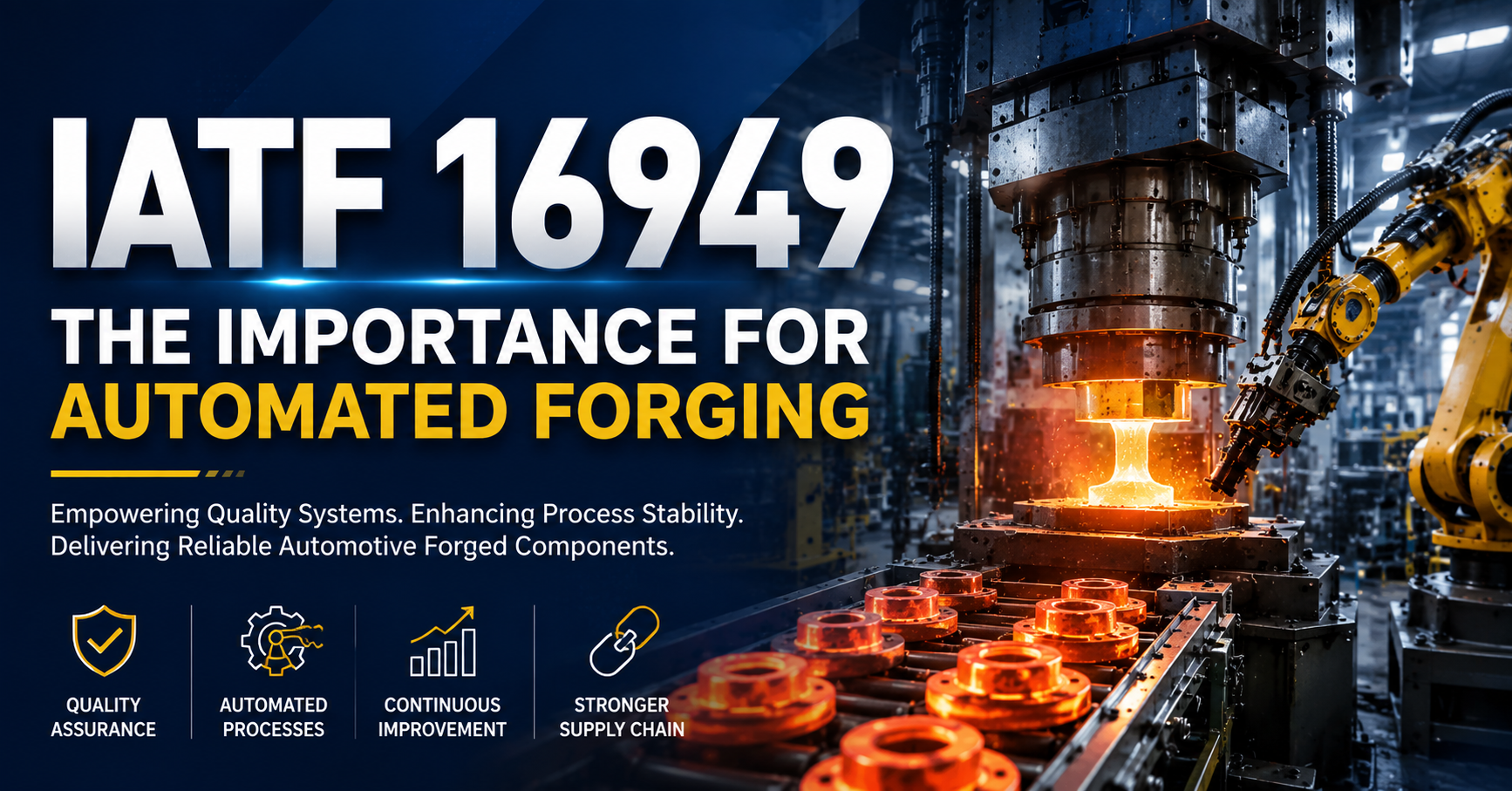
An automated forging line may include several key processes such as heating, automatic loading,forging, transfer,cooling and inspection. An issue at any stage can potentially result in quality problems across a large production batch.
One of the main advantages of automation is reducing manual intervention. IATF 16949 focuses on process management, risk identification, defect prevention, and continuous improvement. This helps manufacturers move from simply detecting problems during final inspection to preventing problems during the manufacturing process.
Improving the Consistency of Forged Components
Consistency is critical in the automotive industry.
For forged components, products must not only meet drawing dimensions but also comply with requirements for material grade, mechanical properties, surface quality, and other customer specifications. IATF 16949 provides the quality management framework that makes this repeatability stable, measurable, and sustainable.
Strengthening Risk Management and Defect Prevention
Automotive forged components often require a high level of reliability. Cracks, dimensional deviations, material issues, or other quality problems can affect the assembly, performance, and service life of automotive components.
IATF 16949 emphasizes risk management, product safety, defect prevention, and continuous improvement.The goal is not simply to identify defective parts, but to identify and control the causes of potential defects as early as possible.
Improving Product Traceability
For automotive customers, finding a quality problem is only the first step. Automated production lines can generate large amounts of manufacturing data. A well-established IATF 16949 quality management system helps manufacturers organize and use this information effectively.
For example, if we find a quality problem, the next question is often:
- Which raw material batch was used?
- When was the part produced?
- Which production line was used?
- Which forging die was used?
- Which machine produced the part?
- Which process parameters were applied?
- What were the inspection results?
- Where was the finished product delivered?
This is the value of quality traceability.
Meeting Increasingly Strict Automotive Supplier Requirements
For forging manufacturers that want to enter or expand within the international automotive supply chain, IATF 16949 can help establish a quality management system that is aligned with automotive industry expectations and enbales the automotive supply chain has a clear supplier structure.
This is important not only for product quality but also for developing long-term relationships with automotive customers and gaining access to new projects.
4. The Manufacturing Advantages of NAO GmbH
For an automotive forging manufacturer, the strongest advantage of real manufacturing value comes from combining:
Automated Production + Forging Expertise + Quality Management + Inspection Capability + Global Supply Chain Support
Nao Schmiedetechnik & Handel GmbH (NAO GmbH) was established in 2015 and is headquartered in Leverkusen, Germany. And we have our own metal forging factory in China.
The company’s production facilities are located in China, with a combined production area of approximately 54,000 square meters. NAO operates 3 MN to 25 MN hot die forging presses and 16 automated forging production lines. The company has also obtained IATF 16949 quality management system certification and relevant Germanischer Lloyd (GL) certification.
If you are looking for an IATF 16949-certified automated forging supplier, or need customized automotive forged components based on your drawings and technical requirements, contact NAO GmbH.
Send us your product drawings, material specifications, annual volume, and technical requirements. Our team can evaluate the forging process, production solution, and quotation for your project.
Sorry, the comment form is closed at this time.